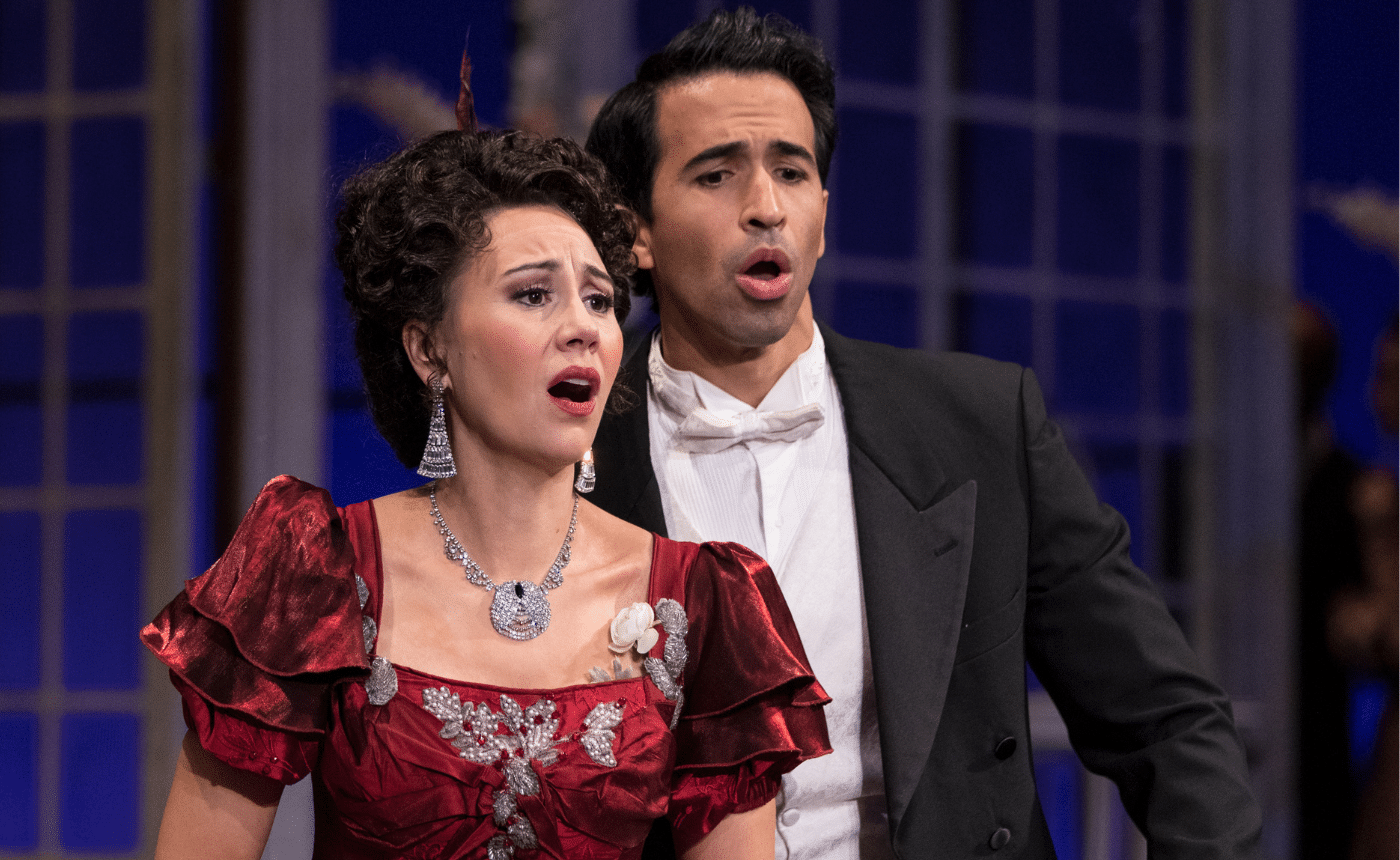
La TraviataA Note from the Director
By Garnett Bruce
“One such woman experienced deep love, she suffered for it and died for it…Her history is exceptional. Had it been common, it would not have been worth writing.”
– A. Dumas-fils, The Lady of the Camellias
FRENCH AUTHOR ALEXANDRE DUMAS-FILS (son of the famous author) scandalized French society with his 1848 novel telling of the demi-monde of Paris: an opaque world of courtesans and their protectors who would lavish them with adornments for a time and then cast them aside when they became old or ill. His subject was based in reality—following the short and vibrant life of Marie Duplessis—while most of the wealthy men in the story were indicated only by their first initial, creating outrage and intrigue. The demi-monde had its own coded language, displaying camellias being one of them, letting suitors know if she was entertaining newcomers or not. The novel was also not shy about discussing the ailments, particularly consumption, that plagued these courtesans. But above all, the story of how a middle-class young man came to win the heart of a glorious (if notorious) woman honors her, reminding readers to look beneath the surface.
By 1853, Giuseppe Verdi had also witnessed the duplicity and condemnation of French society and sought to challenge the elites with this tale of his own time, naming his heroine Violetta. Premiering in Venice, La traviata (The Fallen Woman) did not immediately find its audience. Elite operagoers rejected the critique and stayed away. But soon, everyone recognized the psychological depth and emotional journey of the principal characters in Verdi’s music. Violetta has her public and private faces: “Life of the Party” in Act I, with high-notes and dazzling coloratura; “The Quiet Angel” in Act II, momentarily happy and healthy until she returns to the pressure of Paris; and “Grasping at Life” in Act III, as her breathing and her singing become labored. Through it all, she displays the “exceptional” strength and nuance Dumas-fils describes as she wrestles with her independence and her struggles with a disease, a judgmental society, and ultimately isolation.
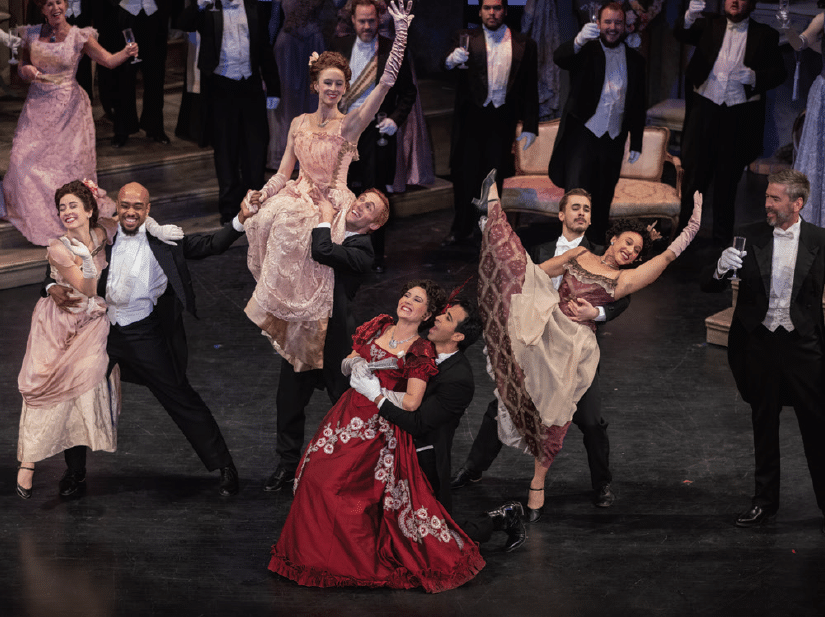
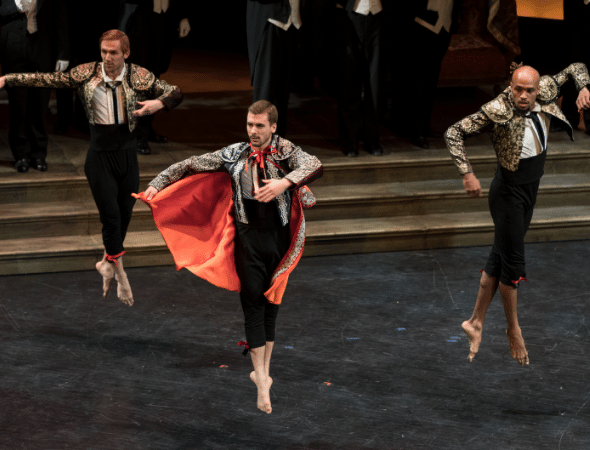
Verdi was quite adept at capturing the allure of movement in music, and in this opera, it’s also a gateway to the honesty, integrity, and desires of Violetta. Dance has always been part of French opera tradition, but even when writing for the Italian audiences (who didn’t require a ballet), Verdi included space for choreography. The chorus hears lively tempi in ¾ time in Act I, and they dance a Spanish pastiche at Flora’s party—Moderato for the fortune-telling ladies, Allegro Assai Mosso for the matadors. Even in the haunting prelude, we hear a gentle waltz descending into the strong melody for the cellos playing a romantic theme before it all vanishes: a life flashing before our eyes.
When creating this staging for Utah Opera, we took the opportunity to include dance throughout. Working with choreographer Daniel Charon, we not only enliven the dances written in the score but also connect them to Violetta’s world of delicacy and decadence: exchanging partners, finding momentary physicality, gestures that are boldly elegant. We expand our worldview of the excess and intrigue that Violetta might have recognized. Our corps of dancers is an extension of society couples surrounding Violetta, celebrating her in one act, moving on without her in another: a subtle reminder of the hollow friendships that will abandon a soul when she is most in need.
You will see a new costume for Act II, as I wanted to imagine a healthy Violetta riding horses across the countryside with Alfredo. The mid-19th century research reveals several independent women altering their skirts, corsets, and petticoats to allow them to ride assertively alongside the gentlemen. I appreciate showing Violetta’s practicality over the finery of the boudoir. Finding her so relaxed, even the elder Germont has to respect Violetta’s integrity, learning she is much more than he expected. The riding costume also offers a great contrast when she has to go back to a more formal look at Flora’s party. The corset and trappings of the period now seem to overwhelm her. By the final act, she’s not even capable of dressing to go outside, with the orchestra thundering away, reflecting her frustration: “Grand Dio, non posso!” (God, it’s impossible). In some eyes, she has fallen from dramatic fashions to barely able to manage a basic housedress, but we are still able to showcase Violetta’s perseverance. The disease may be overwhelming her, the world may condemn her, but those who truly know her find the goodness no matter what she wears.
Above all, our approach relies on theatrical lighting to focus our attention and emotions beyond reality. By framing our stage with vivid color shifts outside the walls, Violetta’s challenges become exponentially bigger than the rooms she occupies. This abstraction underlines musical shifts and character, and better amplifies the complex choices Violetta must make. We have an elegant framework within the built scenery to establish a well-off world with crown molding and faceted windows, but it is the full spectrum of color that we respond to most–colors that tie us to our protagonist’s journey. Verdi shows the way to understand her right from his prelude: dream-like delicate strings, chromatic chords which evolve with transparency and even longing for unrequited love. Here is a vibrant life, cruelly cut short just when it should be flourishing. With a commitment to explore the nuance whenever we stage her story, I hope we are able to echo Alexandre Dumas-fils in finding this woman extraordinary by every standard.